
Exterior Mold and Mildew on Florida Homes: What Removes It
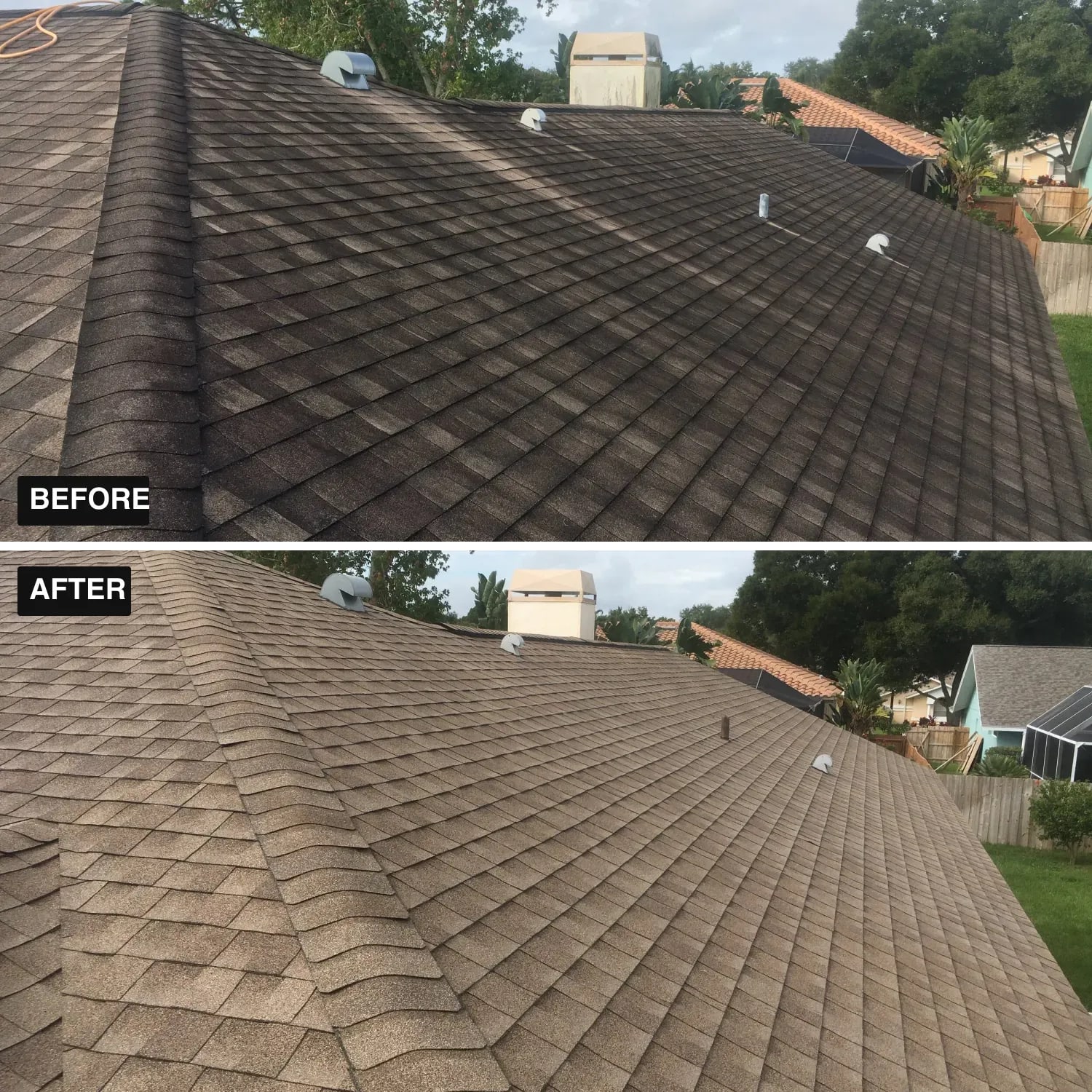
The green and black film on a Florida exterior wall is organic growth living on the surface, and it does not come off with force. Pressure cleans the area around it and leaves what's rooted in the pores, which is why it seems to come back so fast after an aggressive wash. A diluted cleaning solution, dwell time, and a full rinse remove it. This service is not mold remediation.
Cool Breeze has cleaned exteriors in Pinellas County since 1999. This page covers what the growth is, what lifts it, and the line between exterior cleaning and work that needs a different licensed trade.
What is actually growing on a Florida exterior wall?
The film on a Florida exterior wall is usually algae, mildew, and sometimes lichen or moss where a surface stays wet longest. Florida gives organic growth close to ideal conditions: long humid months, warm nights that do not pause growth, daily summer rain, and heavy shade under mature oak.
Telling them apart from the ground is guesswork, so the scope describes what's visible and does not name an organism. If you need to know which one it is, that's a job for someone who samples and tests.
Why doesn't pressure washing remove mold and mildew?
Pressure washing does not remove organic growth, because growth on a porous surface isn't sitting on top like dirt. It's grown into the texture of stucco, the pores of concrete, and the mortar lines of block. Force strips the visible layer and leaves what's rooted, so the wall looks better for a short while, and then the growth shows again.
Force has a downside too. On painted stucco it can peel a coating that was already marginal, on wood it raises grain, and on any wall it can drive water where you did not want it. Our low-pressure versus high-pressure comparison goes through where each one fits.
What actually removes exterior mold and mildew?
What removes exterior organic growth is a diluted sodium hypochlorite solution blended with biodegradable surfactants, applied at low pressure and left to dwell, then rinsed. The surfactant holds the solution against a vertical surface long enough to work. On walls, application stays generally under 100 PSI. The 2,000-plus PSI band is for sound flat concrete, not stucco or siding.
Dilution is set by the material and its documented condition, and the product label governs application conditions, dwell, and rinsing. Where a manufacturer publishes care instructions for your siding or coating, those instructions control the approach.
| Surface or situation | Proposed application | What sets the limit |
|---|---|---|
| Stucco, siding, and painted walls | Diluted solution at low pressure, generally under 100 PSI, with dwell time and a full rinse | Growth is established in the material's texture, so force strips the visible layer and leaves what is rooted |
| Sound flat concrete | The 2,000-plus PSI band | Flat concrete tolerates mechanical force that a wall does not |
| Interior growth, musty odor indoors, or a suspected leak | Out of scope for exterior cleaning | Indoor mold assessment and remediation are separately licensed activities in Florida |
Is exterior cleaning the same as mold remediation?
No. Exterior cleaning deals with visible growth on the outside of the building. It cannot tell you anything about the air inside the house, it does not identify a species, and it does not promise a health outcome. EPA's mold resources are a good place to start on why indoor moisture problems are their own subject. In Florida, indoor mold assessment and remediation are separately licensed activities.
If you're seeing growth inside, smelling must indoors, or dealing with a leak, exterior cleaning will not fix that, and we'll tell you so.
Why does exterior mold come back?
Exterior growth comes back wherever a wall stays damp, so regrowth is about moisture. The walls that come back first are north-facing elevations, anything under deep canopy, walls behind dense foundation planting, and surfaces hit by an irrigation head on a timer. UF/IFAS Extension publishes guidance on Florida landscape irrigation, and moving a sprinkler head off a wall does more about regrowth than any product does.
We do not publish a cleaning interval, because the answer varies with shade, drainage, material, and prior treatment. The signal to go by is what the wall looks like from the ground.
What should a mold and mildew cleaning scope record?
A mold and mildew cleaning scope should record the surfaces included, the proposed method and products, the landscaping precautions, the known limitations, and the price with its service window.
- The surfaces included, elevation by elevation, and what is excluded
- The proposed method and products for each material, with label directions
- Landscaping precautions, pre-wetting, and rinse plan
- Known limitations, including staining that has penetrated the material and coatings that may react
- The price and the service window, with the accepted written quote controlling both
City-specific detail is on the Clearwater, Dunedin, and Safety Harbor pages, and the service overview has the full method. If the roof shows the same problem, the soft wash roof cleaning page covers that surface.
Exterior mold and mildew FAQs
Is the green film on my wall mold or algae?
Often algae, sometimes mildew, and commonly a mix. A webpage cannot identify what's on your wall, and neither can a cleaning crew from the ground.
The written scope describes the visible condition being treated. It does not name a species, because identifying one is a different field.
Does exterior cleaning help with indoor mold?
No, and it should not be sold that way. Cleaning the outside of a wall cannot tell you anything about the air inside.
It cannot identify a species, and it does not deal with a moisture source inside the building. Suspected indoor contamination needs a properly licensed assessment, which in Florida is a separate trade.
Why does it come back on the same wall?
Because the conditions that fed it are still there. Shade, poor drying, irrigation overspray, and plants tight against the wall all keep a surface damp.
Cleaning removes what's there now. How fast growth returns depends on those conditions and on the material itself.
Can I just use bleach from the hardware store?
People do, and the risks are the ones you'd expect: uneven results, damage to plants below, staining on nearby surfaces, and a ladder.
Product labels set dilution, application, and rinse rules that are easy to get wrong. No method, ours included, is risk-free.
Green film on the shaded side of the house? Call 727-584-6622 or request a free written quote online. Quick answers on the FAQ page.